Biography of Hayk Safaryan
Aik Safaryan often employs unconventional methods when he creates. At times even revolting against high academia, and its assumed master techniques that are all too commonly used. He uses mixed media, heavy layering, erasing and reduction methods which bring to life unique cosmic effects, a visual compote never before explored nor experienced.
During the creation of the piece, Safaryan enjoys a brutal approach, using a wide range of tools and knives as his paint applicators. He often follows industrial techniques of mixing media with pigments, as well as mixing the paint with other substances, permitting him to explore new realms of visual art; These next-level realms feature colors with heightened vibrancy, making them feel like living life-forces.
To capture these vivid visions, Safaryan must strictly apply uncompromised ideas, and the process must be challenging. His medium is totally fantastic, spaceless, timeless, in which forms are fractured, colors are brave, brutal and sometimes even terrifying. Colors that fuel uncontrolled hallucinations accompanied by fierce excitement. His art is hybrid ; Brutal, yet tender. The abstract and organic forms often speak to his fascination with architecture and industrial design. And his approach is almost calculated, the layers build on top of one another, mimicking the art of the craft more than the art in itself.
Safaryan has been involved in the New York design, architecture and construction industry for over fifteen years. Managing a wide range of projects that benefit business, individuals, education, culture, families and the New York infrastructure.
1981–1987: Early years in a safe and intellectual atmosphere
Hayk Safaryan was born on September 25, 1981, in Yerevan, Armenia, then part of the Soviet Union. His father, Edward Safaryan, was a chemist who also worked in politics. His mother, Varduhi Parsamyan, was a homemaker with an academic background in linguistics, fluent in five languages. Hayk was the eldest child with two siblings, his sister Arevik, and his brother Sevak, who followed shortly after.
Life in Soviet Armenia felt stable and predictable in the early eighties. The society was very functional, which created a sense of order and ease, even as conditions varied across the larger union. Hayk was born into a secure atmosphere, in a home lined with books and vinyl records, with conversations about science, culture, and the arts at the dinner table. The humanities thrived: culture, arts, and sciences were treated as core and actively supported.
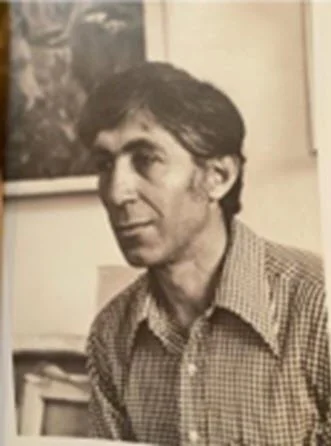
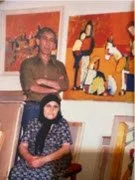
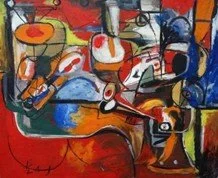
From an early age he gravitated toward the creative world, although his father encouraged him to follow a scientific path and steered him toward sports, mathematics, and chemistry. At age six he began tennis lessons as well as piano studies. However, outside school and his parents’ chosen extracurricular activities, he spent most of his time at his uncle’s art studio, not far from his home. His uncle, Bagrat Grigorian, was a prominent Soviet painter with wide international recognition, whose work had been shown in major studios and galleries across the country until he was banned as an artist when charged with being heterodox, in opposition to the Soviet regime. Despite this, throughout Europe, North and South America, the Middle East, and Asia, his art was on exhibit and in high demand.
Uncle Bagrat played a huge role in Hayk’s early developing years as one of his major role models. After school Hayk would spend hours watching him paint and learned to love the smell of oil paint and canvas. His uncle’s studio became his place of refuge, where he could drift and lose himself in color and landscape. There was no limit to how far his imagination could travel.
His mind was active and stimulated beyond ordinary bounds. His uncle’s stories of travels, accompanied by the landscapes and colors in his paintings, spoke to Hayk in a profound way.
He listened to his uncle converse with his circle of artist friends as they discussed the difficulties and the importance of freedom of expression during the oppressive communist era. He listened and learned to comprehend the concepts of struggle and fear, met with resilience and the importance of fulfilling the need to create. He was exposed to conversations about the tactics used by the communist regime to suppress artists, and how they navigated those pressures without compromising integrity.
Through watching artists gather in his uncle’s studio, a young Hayk understood how a community supports its members through a grim political and social reality, as hours were spent discussing hardships and enthusiastically helping one another whenever needed. This is when Hayk came to understand the true value of community.
These “golden years” laid down a foundation that Hayk would lean on for the rest of his adolescent and adult life, which later presented him with many hardships as the world around him fell to pieces. The security of his early years was necessary to give him some sense of what safety and non-impoverished, non-war-ridden circumstances looked like.
Bagrat Grigorian
Bagrat and mother
Lot 73 Bagrat Grigorian
1988: Spitak Earthquake
The late eighties and the early nineties turned stability into hardship. At age seven, Aik experienced his first intense hardship when the Spitak earthquake struck Armenia in December 1988. The 6.8-magnitude earthquake killed an estimated 25,000 to 50,000 people, injured more than 130,000, and left hundreds of thousands without homes. While Yerevan only endured slight destruction, Leninakan (now Gyumri) was in ruins, and basic services started failing across the region.
Aik lost many relatives at this time. His parents emptied his closet for children who had nothing, loaded their car with food, clothing, and medicine, and went to the disaster zones to help pull survivors from rubble. His grandmother cared for him, his three-year-old sister, and his one year-old brother. She would cry every night while his parents were away. The deep-rooted dark shadow many elderly Armenians carried because most of their families had been murdered during the genocide reemerged during times of despair. The genocide, which took place between 1915 and 1916, resulted in the killings of approximately 800,000–1,300,000 Armenians, among whom all of Aik’s grandparents’ parents had been brutally murdered.
When his parents finally returned from Leninakan, they brought along a displaced family who had just lost their five-year-old daughter, most likely dead in the rubble. This family lived in the Safaryan home for over a year.
1991: Collapse of the Soviet Union
On December 25, 1991, Aik recalls sitting on a rug and watching the collapse of the country on television as the Secretary of Parliament, Mikhail Gorbachev, publicly resigned. Despite the brutal regime, the Soviet Union had been a country of law and order. All that came crashing down, and the Soviet Union officially collapsed the following day.
Aik felt and knew that conditions were going to change drastically and accepted the notion that it would take a while before life moved from surviving back to thriving. It was a time of extremes in all aspects of life. The gatherings at his uncle’s studio came to a halt, as many artists were forced to join the Armenian forces. Precious time spent drifting away into oil and canvas ended abruptly, and mere survival took its place.
1992: War and Uncle Bagrat’s sudden death
The conflict over Nagorno-Karabakh, the first war between Armenia and Azerbaijan, intensified to its heaviest period, causing desperation in the country. His father was among the thousands forced to leave their families and defend their homeland. Daily life narrowed to survival by candlelight, with long lines for bread and with no running water, electricity, or heat for years. Army tanks became a daily sight.
Aik stood in winter lines for bread, dug pits to keep food cold, helped his mother churn milk and cheese by hand, and did whatever was needed to keep his family safe. The hardship fixed in him a lasting sense of scarcity, the value of a safe home, and a dedicated duty to help others whenever in need.
Amid this chaos and hardship, Uncle Bagrat was diagnosed with an advanced stage of a very aggressive, rare cancer, which he died of just a few months later at age 53. Aik was beside himself over this loss, his first true heartbreak.
1995–2002: Focusing on his studies helped him cope with the hardship
Aik was a very engaged student in high school despite the bleak conditions that surrounded him, still with rare access to heat and electricity and seeing military tanks cruising the streets every day. Educating himself to his highest potential became a coping mechanism, and he also attempted to paint whenever he could secure supplies.
In high school, Aik was especially interested in geometry, geography, and history. Despite his parents’ prior hopes for him to excel in science, his attention constantly returned to the foundations of form and function, to the way materials interact, and to how spaces make people feel, laying the groundwork for his future pursuit of industrial design.
He graduated from high school in 1997 and was accepted to the State Academy of Fine Arts, in Yerevan, the same year. At the Academy, he studied composition, geometry, art history, and painting techniques, later shifting his interest to industrial design, following in the footsteps of his late Uncle Bagrat and his aunt Emma (also an acclaimed painter), who had both studied industrial design and painting at this prestigious Academy. Aik graduated in 2002 with a degree in industrial design and was accepted to the College for Creative Studies in Detroit, Michigan.
2002: Aik arrives in America
Aik first arrived in America on June 12, 2002, landing in New York City on a student visa at age nineteen. He spent the day wandering the city and was immediately drawn to its energy, knowing at once that he would one day live and work there. The following day he traveled halfway across the country by bus for sixteen hours to Detroit, Michigan, through the mountains of Pennsylvania and the plains of Ohio. For the first time in a long time, he felt free and secure. He fell in love with the nature and greenery.
At CCS he majored in industrial design. He focused on materials and their behavior. He deepened his knowledge of product development, ergonomics, function, and systems. He learned how materials interact in architecture, and he studied safety and United States standards.
Upon moving to New York, he found comfort in his aunt Emma, Uncle Bagrat’s surviving older sister, who had since moved from Armenia to settle in Queens to pursue her painting career. She inspired Aik to rent a small painting studio, looping him back into the family’s artistic legacy.
He would paint in his spare time. Through every step of the way during his time in New York, he tried to do his best to keep up his painting. Over the course of two decades, he rented a handful of different studios for shorter periods whenever possible. He would show work when he could.
Aunt Emma introduced Aik to the accessible side of the art world in New York, by inviting him to partake in a few of her exhibits, which were his New York Debuts, leading to further art shows of his own and with friends over the many years to come. Aik has felt very grateful that she helped him continue to find time for his passion and never lose sight of his desire to follow in the footsteps of his Uncle Bagrat’s noble struggle to discover himself as an artist.
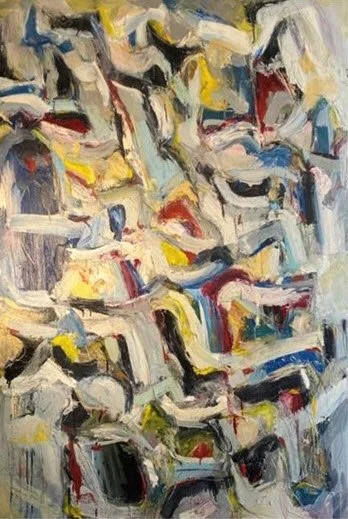
Aik Safaryan Oil on Canvas Untitled
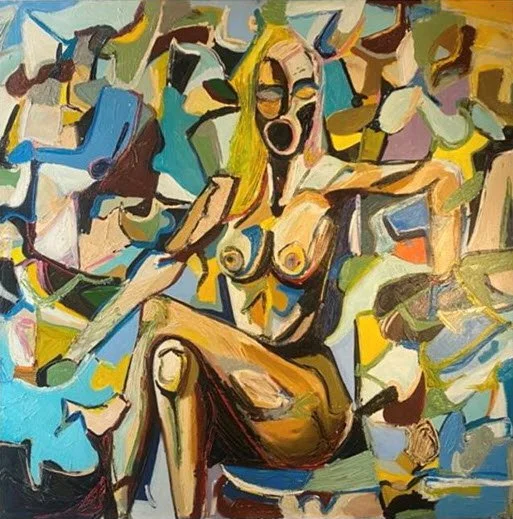
Aik Safaryan Oil on Canvas Inflatable Lola
Carrying on his uncle’s legacy has provided Aik with a profound sense of meaning in life that he can turn to when facing his hardest times. Sporadically across the two decades he has continued to paint whenever he finds the time.
After five years of freelance work, Hayk was seeking greater financial stability and joined GCNY Builders Group as a project manager. After successfully managing several large projects, he was promoted to Senior Project Manager and, shortly thereafter, to Managing Partner. He oversaw complex projects across New York and New Jersey, working closely with mechanical, electrical, and structural engineers and with architects, and he gained a comprehensive understanding of the construction industry.
2017 - 2023: Conceptualizes and founds Neuehaus Studios Inc.
In 2017, he laid down the foundations for his own company, Neuehaus Studios Inc. He obtained a New York City general contractor license and officially began operations in early 2018. From 2018 to 2020, the firm completed more than 80 complex projects. Work finished on time and on budget. Designers, architects, and clients trusted him with schedules, punch lists, keys, and more because he told the truth about timelines, and he always finished what he started.